Behind the build
Wrriten
From a broken product to a paper writing studio.
Web · Product strategy
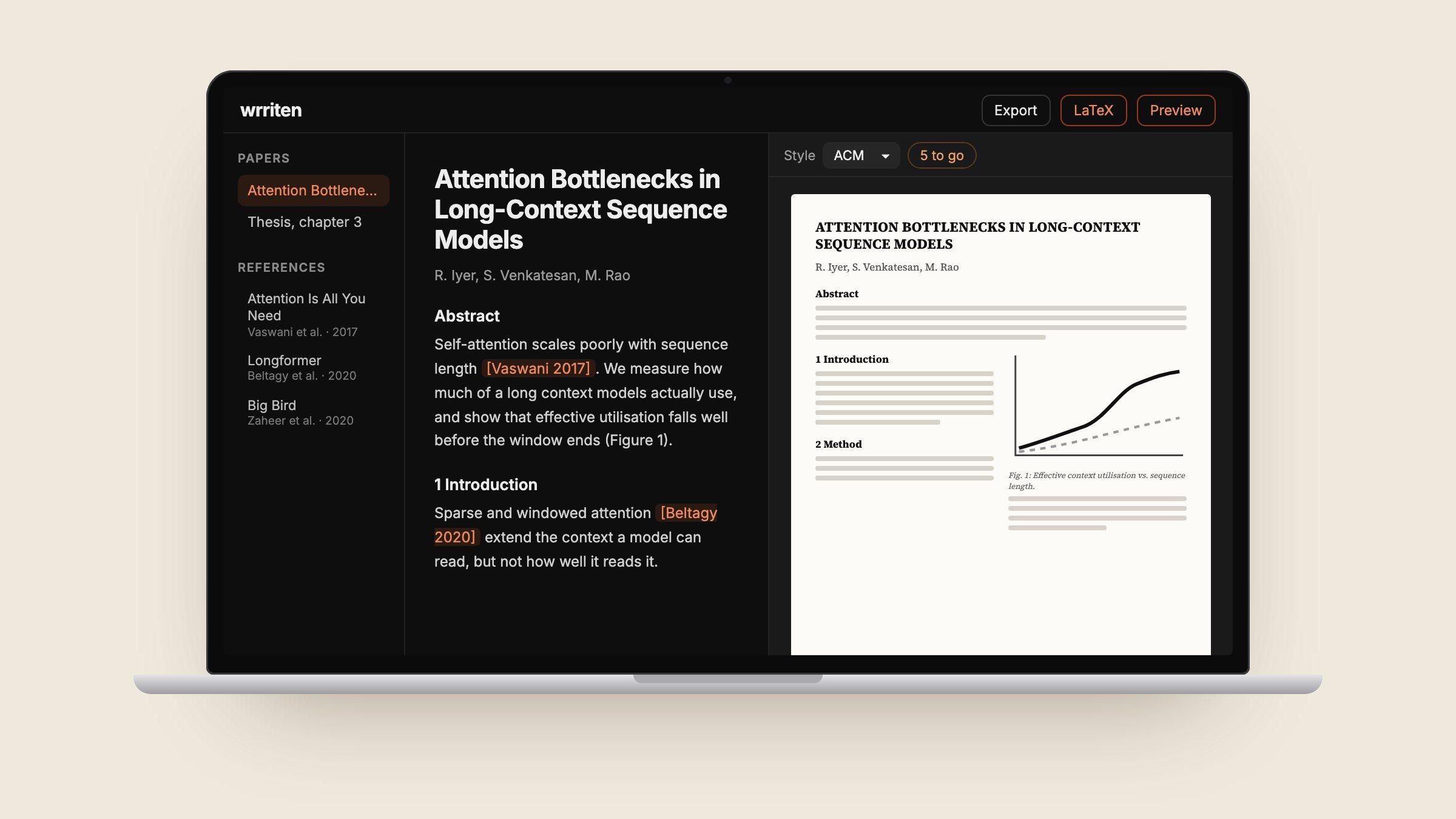
Wrriten began as a product that was not working. Docable was a documentation tool, and its founders knew it had to change. They came to us with a belief rather than a brief: individual researchers in India, the PhD student, the postdoc, the author on a first paper, work with almost no proper tooling.
- Engagement
- Product discovery, pivot, design, engineering and launch
- Platform
- Web
- Our role
- Product strategy, customer research support, UI and UX design, web app engineering, backend and cloud, LaTeX typesetting, billing and launch
- Technology
- Next.js, React, TipTap, ProseMirror, LaTeX, Firebase, Google Cloud
The bet
The founders had bought into one idea: serious research is done in India by individuals, and almost none of the tooling around it is built for them.
A PhD student writing alone has no lab manager, no typesetter and no team license. They have a laptop, five open tools and a deadline.
Docable did not answer that. It was made for software teams and product managers writing documentation, and it showed. The challenge was to turn a product that was not working into one researchers would actually open, without starting from zero and without a large budget.
The real problem
Every journal and conference wants its own layout, citation style, figure rules and checklist.
Get one wrong and the paper comes back. Get rejected and you start again for the next venue. Wrriten had to give one person, often writing a first paper, a single place to write once and fit any venue, without learning LaTeX.
How we found the way
We worked in five steps, and went back to earlier ones whenever the evidence said we should.
- 01
Name what was broken
We looked honestly at Docable and asked what it did well and what nobody wanted. The editor was worth keeping. The audience was wrong.
- 02
Go to the people who write papers
Students, PhD researchers and professors told us about their last paper and what actually happened. Everyone had a different setup. Most described it as all over the place, but it gets the job done.
- 03
Pick the one job to do better
Fitting a paper to a venue. The pain peaks at write up and defense, and no tool treated formatting as the core job.
- 04
Build the spine first
Wrriten stores what each part of a paper is, a title, a figure, a citation, and applies the look on top. Switching venue becomes a switch, not a rewrite.
- 05
Ship, watch, adjust
We put it in front of real writers, judged it on whether they came back, and adjusted the product as the story changed.
What we built
We built Wrriten out of the broken product. We kept the editor, dropped what only developers needed, and rebuilt everything around one job: write a research paper once and fit it to any journal or conference.
Write like a document
Mark the title, authors and abstract as what they are, and the venue decides how they look.
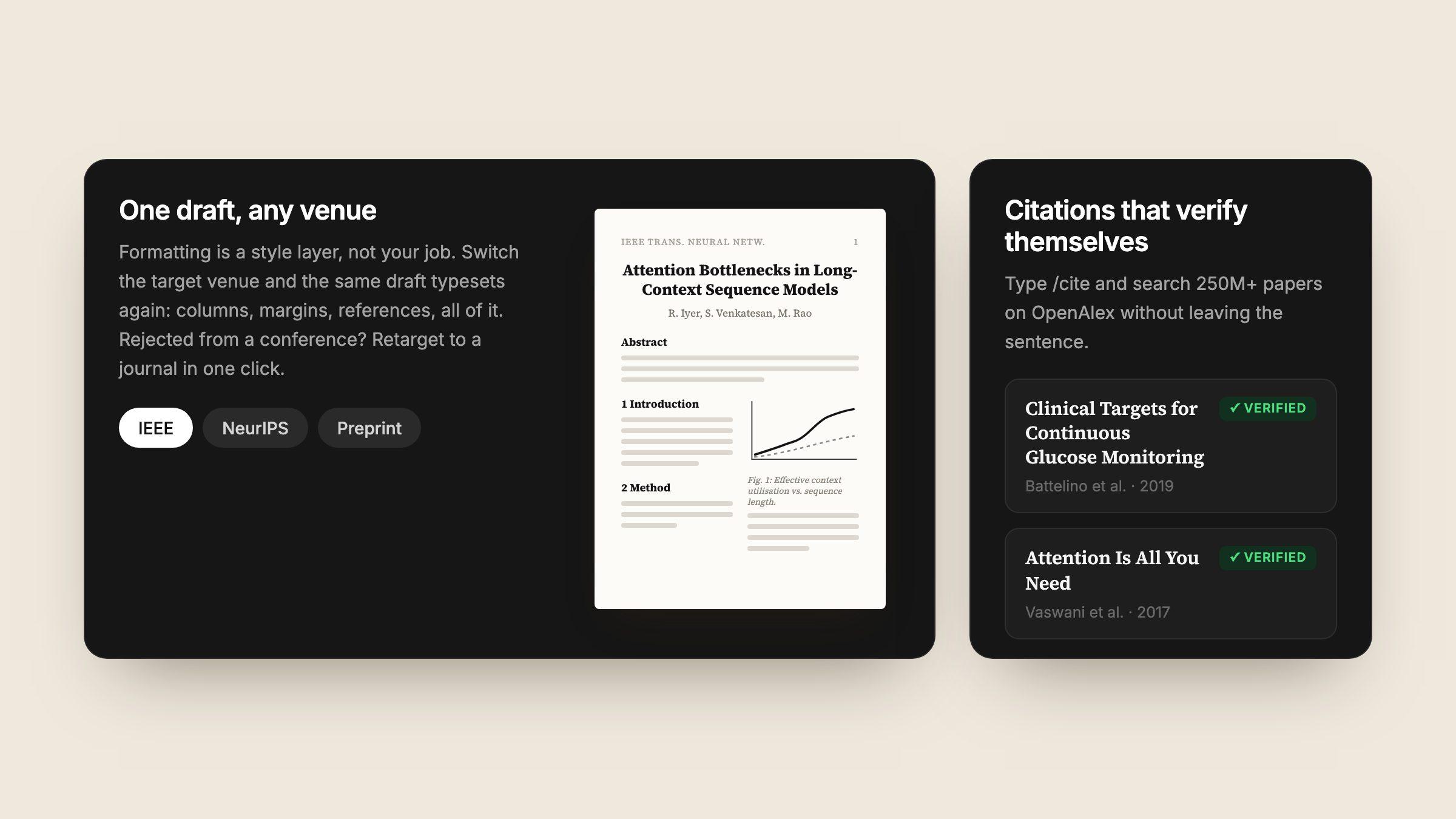
Switch venue from a dropdown
Pick IEEE, NeurIPS, ACM or a preprint. The whole paper retypesets and the bibliography follows.
A submission checklist
It shows what a venue needs and the paper still lacks.
Figures that behave
Captions, side by side panels, and references like Figure 3b that stay right when you reorder.
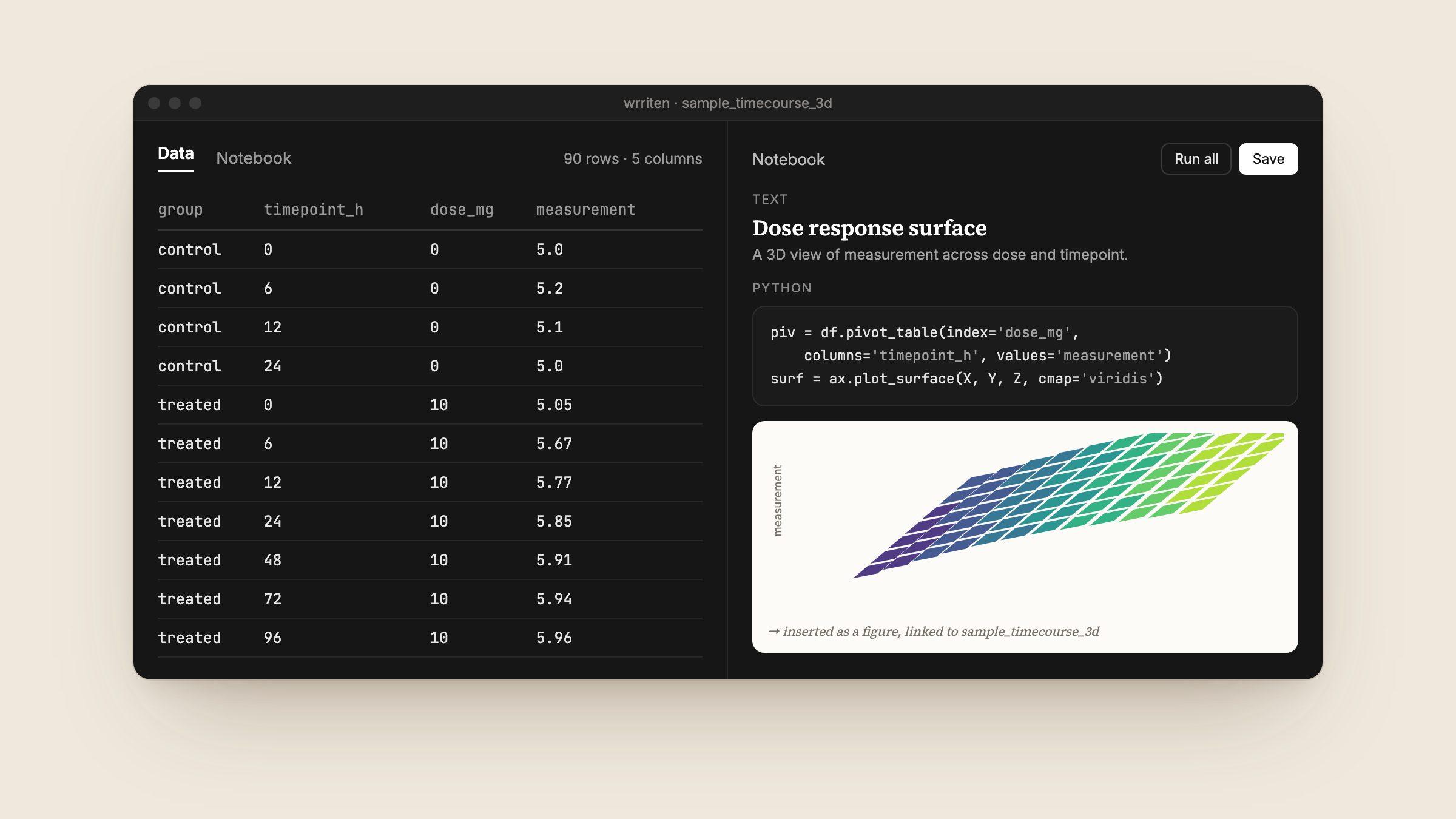
Data and figures in one document
Open a dataset and a notebook beside the paper, and the figure lands in the manuscript still linked to the data.
Citations that verify themselves
Type /cite and search 250M+ papers on OpenAlex. Import a PDF, highlight it, and cite straight from the highlight.
LaTeX export
The file a venue compiles is the one Wrriten produces, plus a PDF.
Accounts, plans and billing
Cloud saved papers, nothing to install, and a free plan to start.
The call we're proudest of
Most writing tools store a page that looks a certain way. We made Wrriten store what each piece of the paper is, and apply the look on top.
That one choice is why changing the venue is instant, and why the preview, the export and the checklist always agree.
Where it stands
One windowinstead of five tools. That is the promise Wrriten is built around.
May 2026
Docable pivots to research writing
June 2026
Students and professors shape what we build
Jun–Sep 2026
Editor, venue formatting, figures and citations take shape
October 2026
Docable becomes Wrriten
Wrriten is live. A researcher can open it, write a paper, choose a venue and export a file ready for submission.
We launched early and in public, and grew it the honest way: conversations with students and researchers, founder posts about what is being learned, a short product demo, and a survey passed around through a professor's network. We judge it on whether someone comes back to write the next section, not on compliments.
A product that was not working became one with a clear audience, a clear job and a name that fits. For us it is the clearest example of how we work: understand the problem first, build the spine before the surface, and let real behavior decide what comes next.
“I myself am a Software Engineer, and the level of quality I was expecting from the engineers at Echeos was already high. They broke that ceiling at every step, and it was an absolutely amazing learning curve for me. They don't just build products, they literally own them.”